June 26, 2026
Energy resilience is the conversation.VIPV is part of the answer.
Energy resilience has moved from a niche infrastructure topic to a mainstream business concern remarkably quickly. Boardrooms that never previously discussed grid dependency are now asking what happens to operations when supply is uncertain, prices spike, or infrastructure fails to keep pace with demand. It is a reasonable question, and it does not have a single answer. But one piece of it is less discussed than it should be.
Vehicles can generate their own energy. And when they are designed to do so from the ground up, on a platform built light by principle, they become something more than transport.
The grid dependency nobody talks about
The transition to electric vehicles is broadly understood as a climate positive. And it is. But it contains an assumption worth examining: that a reliable, affordable, and sufficiently dense charging infrastructure will be available wherever and whenever fleets need it.
In many parts of Europe, that assumption is already under pressure. Public charging deployment is running behind the targets set by AFIR, the EU’s alternative fuels infrastructure regulation. Grid capacity constraints in urban areas are delaying depot electrification projects. Energy prices remain volatile. The EV transition, for all its genuine progress, has inherited a structural dependency on infrastructure that is still catching up with ambition.
For organisations running light urban fleets, this is not a theoretical problem. It shows up as planning constraints around charging availability, and as exposure to energy costs that are harder to predict than fuel once was.
What energy independence actually looks like at vehicle level
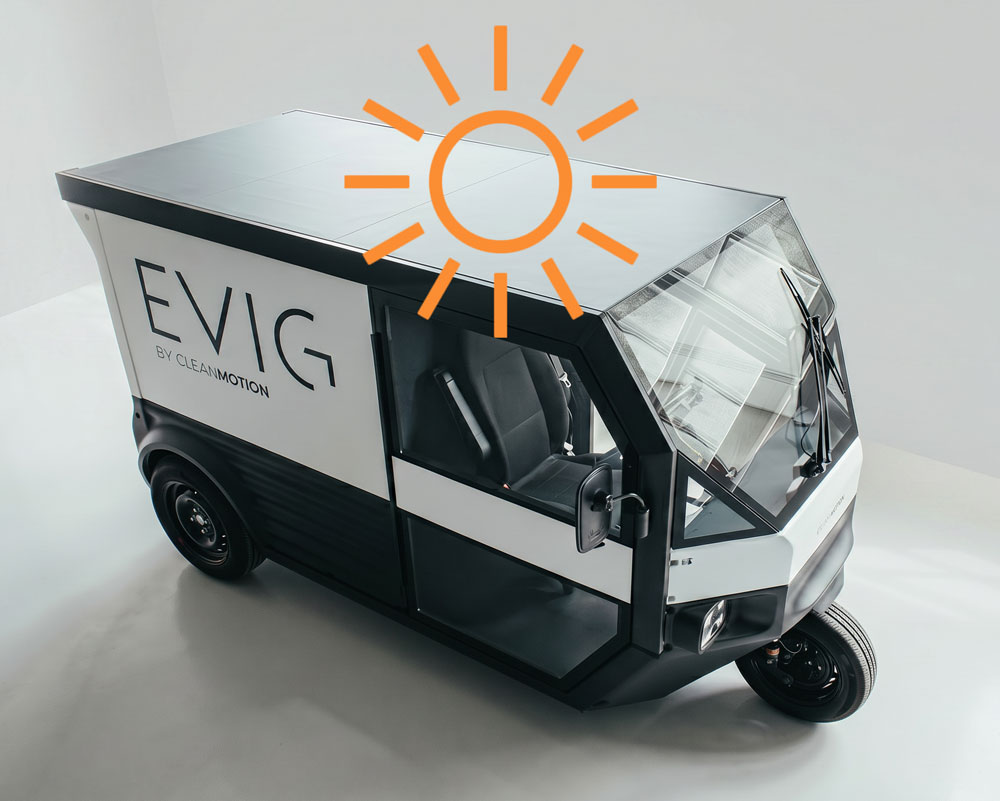
Vehicle-Integrated Photovoltaics, or VIPV, addresses this at the point where the energy is actually used: the vehicle itself. Unlike bolt-on solar panels added as an accessory, VIPV integrates photovoltaic cells directly into the bodywork of the vehicle, making solar generation a core architectural feature rather than an afterthought. The result is a solar-powered vehicle that generates renewable electricity as it operates, feeding the drivetrain and, in the right conditions, covering its full daily energy demand without any grid input.
This is not a supplementary feature. On a vehicle designed with solar as a core architectural principle, the yield is a genuine operational input that changes how the vehicle is used and planned around. The vehicle is not simply consuming energy. It is producing it.
The implications of that shift are larger than they first appear. A solar-powered vehicle is less exposed to tariff volatility. It operates more freely in areas where charging infrastructure is limited. It reduces the load on depot charging systems, which matters as fleets scale. And it does all of this passively, without additional operational steps, because the energy generation happens as part of normal use.
VIPV as distributed energy infrastructure
Zoom out from the individual vehicle and the picture becomes more interesting still. A fleet of solar-powered vehicles is not just a collection of transport assets. It is a distributed network of small-scale renewable energy generators, operating across urban environments, producing clean electricity wherever they are parked or moving.
This is relevant to the energy resilience conversation at a systems level. Centralised energy infrastructure, whether grid substations, large-scale renewables, or charging hubs, is inherently vulnerable to single points of failure. Distributed generation, spread across many small nodes, is structurally more resilient. A VIPV fleet contributes to that resilience without requiring any additional infrastructure investment, because the generation capacity is already embedded in the vehicles.
For public sector operators and municipalities thinking about energy resilience as a policy objective, this is worth taking seriously. Vehicles that generate energy in operation are assets in a broader sense than their transport function alone. They are mobile renewable infrastructure.
The lightweight condition, again
None of this works without the right vehicle design. VIPV on a heavy platform is a marginal contribution at best. The energy physics are unforgiving: a heavier vehicle needs more power, which requires a larger battery, which adds weight, which demands more power.
Genuine energy autonomy through solar-powered vehicles requires a platform designed to be lightweight by principle, not by accident. Right-sized for its actual use case, with every design decision made in service of the energy logic. That is the condition under which solar stops being a feature and starts being a system. Lightweight is not a constraint. It is what makes VIPV work in practice.
Why this matters now
The energy resilience conversation is not going away. If anything, the combination of grid pressure, geopolitical volatility in energy markets, and accelerating electrification of transport is going to make it more urgent. Organisations thinking carefully about their exposure to centralised energy infrastructure are asking the right question.
Solar-powered, lightweight vehicles do not answer that question on their own. But they contribute something most other approaches do not: generation capacity embedded in the assets that already need to move. No additional footprint, no additional infrastructure, no additional operational complexity.
Want to know more about EVIG and VIPV?
Read the companion post on how VIPV works and why lightweight is the enabling condition.
You may also like